
Working with independent contractors can help businesses control costs, access specialized skills, and complete projects without expanding their permanent workforce. For businesses in Corpus Christi and throughout South Texas, contractors can be especially valuable when demand changes, projects become more complex, or specialized services are needed. Construction companies, property managers, professional service providers, retailers, and other local businesses regularly rely on outside professionals to keep operations moving.
However, hiring an independent contractor also creates legal and financial responsibilities. A poorly written agreement, unclear project expectations, inadequate insurance documentation, or incorrect worker classification can expose a business to disputes and unexpected expenses. Whether you are hiring a freelance designer, an IT specialist, a construction subcontractor, or a maintenance professional, taking the right precautions before work begins can help protect your business. Understanding these safeguards is an important part of responsible business planning, and Brodersen Law can help business owners address the legal issues that arise when working with independent contractors.

Understand the Difference Between an Employee and an Independent Contractor
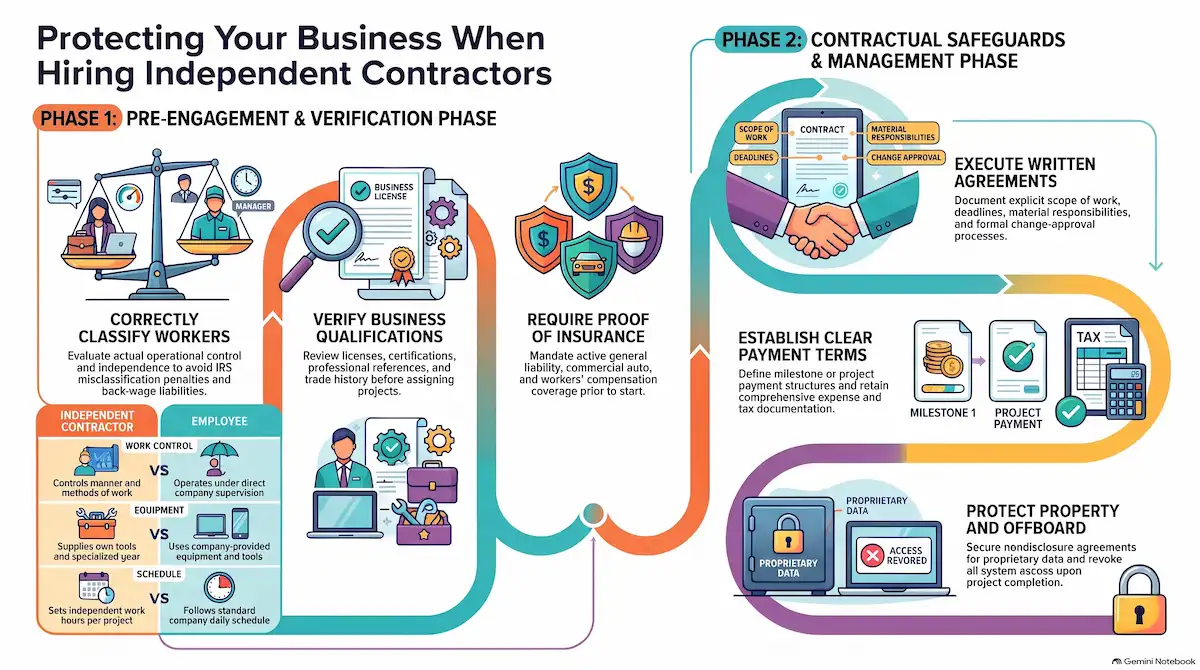
One of the most important steps in protecting your business is correctly classifying the people you hire. Calling someone an independent contractor in a written agreement does not automatically make that person one under the law. Government agencies look at the actual working relationship, including how much control the business has over the worker and whether the individual operates an independent business.
The Internal Revenue Service considers factors involving behavioral control, financial control, and the relationship between the parties. For example, a contractor who advertises services to multiple clients, supplies their own equipment, negotiates project fees, and determines how to complete the work may demonstrate greater independence than someone who follows the company’s daily instructions and works under its direct supervision. No single factor automatically decides every classification question.
Texas businesses should also understand that different legal requirements may use different classification standards. The Texas Workforce Commission explains the importance of direction and control when evaluating employment status for unemployment tax purposes. Federal wage-and-hour rules have their own legal framework, and the U.S. Department of Labor announced a proposed rule in February 2026 concerning independent contractor classification. Businesses should not assume that one classification test automatically resolves every tax, wage, unemployment, or workers’ compensation issue.
For additional guidance, review the IRS explanation of independent contractor classification and the Texas Workforce Commission’s independent contractor tests. When the relationship is unclear, seek legal advice before treating a worker as an independent contractor.
Always Use a Written Independent Contractor Agreement
A written agreement is one of the most effective ways to reduce misunderstandings and establish clear expectations. Verbal arrangements may seem convenient when hiring someone for a small project, but they can create problems if the contractor misses deadlines, delivers unsatisfactory work, requests additional payment, or disagrees about who owns the finished product.
Your agreement should explain the services being provided, project deadlines, payment terms, responsibilities, and conditions for ending the relationship. It should also identify what the contractor must supply, such as tools, materials, equipment, or specialized software. If the project involves multiple stages, describe the expected deliverables and when each payment becomes due.
For example, a Corpus Christi business hiring a contractor to repair a commercial property should specify which areas are included, what materials are approved, who handles permits when required, and how additional work must be authorized. A contractor should not be able to create unexpected expenses simply because the original project description was vague. Clear written terms give both parties a practical reference if disagreements occur.
Define the Scope of Work and Payment Responsibilities
Many contractor disputes begin when the business owner and contractor have different expectations about what the project includes. A general statement such as “complete property repairs” may leave too much room for interpretation. Instead, describe the specific work, quality standards, materials, delivery requirements, and completion dates.
Payment terms deserve equal attention. Specify whether compensation is based on a fixed project price, hourly work, milestones, or another agreed arrangement. Explain when invoices must be submitted, how quickly payment will be made, and whether expenses require advance approval. If a contractor requests additional work outside the original agreement, require written authorization before the extra services begin.
For businesses managing construction, renovation, or maintenance projects in South Texas, this documentation can be particularly useful. Weather delays, material availability, and scheduling changes can affect projects in Corpus Christi and surrounding coastal communities. A well-prepared agreement should explain how the parties will handle delays, change orders, and unexpected conditions rather than leaving these matters to informal conversations.
Verify Licenses, Insurance, and Business Credentials
Before allowing a contractor to begin work, verify that the individual or company has the qualifications required for the specific service. Certain trades and regulated activities may require state or local licensing, registration, permits, or other approvals. Requirements vary depending on the work, so business owners should check the applicable Texas licensing agency and local authorities instead of assuming every contractor follows the same rules.
Insurance is another important consideration. Depending on the project, ask for proof of general liability coverage, commercial auto insurance, professional liability insurance, or other appropriate policies. If the contractor has employees or uses subcontractors, clarify how those workers are covered and who is responsible for workplace safety and insurance obligations.
This is especially important for South Texas businesses hiring roofing, electrical, plumbing, concrete, landscaping, or property maintenance contractors. A serious accident or property damage incident can become expensive when insurance responsibilities are unclear. Request current certificates of insurance, confirm that coverage is appropriate for the work, and consider requiring notice if a policy is canceled or materially changed. A certificate should not be treated as a substitute for reviewing the actual coverage terms when the project carries significant risk.
Protect Your Business With Confidentiality and Intellectual Property Terms
Independent contractors may have access to sensitive business information, customer records, pricing details, marketing plans, software systems, or internal procedures. Without appropriate safeguards, confidential information could be shared with competitors or used for purposes unrelated to the project.
A confidentiality provision should identify the information that must remain private, explain how it may be used, and establish what happens when the working relationship ends. Depending on the type of work, the agreement may also require the contractor to return company documents, delete authorized copies of sensitive information, and protect access credentials.
Intellectual property ownership should also be addressed before work begins. For example, if a Corpus Christi company hires a freelance designer to create a logo, website, photographs, or promotional materials, the agreement should clearly explain who owns the finished work and what usage rights are granted. Do not assume that paying for a project automatically transfers every copyright or intellectual property right. The appropriate ownership language depends on the type of work and applicable law.
Establish Safety and Site Access Rules
Businesses that hire contractors to work at commercial properties, construction sites, warehouses, or customer locations should establish clear safety expectations. Even when a contractor operates independently, the business should communicate relevant site hazards, restricted areas, emergency procedures, and access requirements. These precautions can help reduce accidents and protect employees, customers, visitors, and property.
South Texas businesses may face additional project considerations involving intense heat, heavy rain, coastal weather, and storm-related damage. Contractors working outdoors should understand site conditions and applicable safety requirements before starting. For construction and property improvement projects, document who is responsible for securing equipment, maintaining a safe work area, handling debris, and reporting incidents.
Do not rely on a general contract clause to address every safety concern. The agreement and project procedures should reflect the actual risks involved, and businesses should confirm that their insurance and safety practices are appropriate for the work.
Keep Records of Contracts, Payments, and Communications
Good documentation helps businesses demonstrate what was agreed upon and how the contractor relationship operated. Maintain signed agreements, invoices, payment records, project updates, certificates of insurance, licenses, and approved change orders in an organized location. Written communication is especially useful when the parties discuss schedule adjustments, additional expenses, or changes in project responsibilities.
Tax documentation is also important. Businesses should collect the appropriate taxpayer identification information and determine whether payments must be reported using Form 1099-NEC under current IRS requirements. Reporting obligations depend on the payment type, recipient, and applicable exceptions, so confirm the rules rather than assuming every contractor receives the same tax form.
Consistent records can also help identify problems early. If a contractor repeatedly misses deadlines, requests unapproved payments, or fails to meet agreed standards, written documentation provides a clearer basis for addressing the issue.
Review the Agreement Before Ending the Relationship
Even a successful contractor relationship can eventually come to an end. A project may be completed, business priorities may change, or performance issues may require termination. Your agreement should explain how either party can end the arrangement, what notice is required, how outstanding payments will be handled, and what happens to unfinished work or company property.
Before closing the relationship, confirm that all agreed deliverables have been received, access to business systems has been removed when appropriate, and confidential materials have been returned or handled according to the agreement. If a dispute arises over incomplete work, unpaid invoices, or alleged contract violations, review the written terms before taking action. A thoughtful termination process can prevent a manageable disagreement from turning into a larger legal dispute.
Protect Your South Texas Business Before Problems Arise
Independent contractors can provide valuable flexibility and expertise, but the benefits come with responsibilities. Proper worker classification, detailed written agreements, insurance verification, confidentiality protections, clear payment terms, and organized records can reduce unnecessary risks and help businesses maintain productive working relationships.
For companies in Corpus Christi and across South Texas, these precautions are particularly useful when managing construction projects, property improvements, seasonal workloads, and specialized business services. The best time to address legal concerns is before a contractor starts working—not after a disagreement or unexpected expense occurs.
Brodersen Law can help business owners review contractor agreements, identify potential legal risks, and develop practical protections for their operations. Taking the time to establish clear terms today can help your business avoid costly misunderstandings and build stronger professional relationships for the future.