
When a loved one passes away, one of the first questions family members often ask is, “How long can probate take in Texas?” The answer depends on the circumstances of the estate. Some straightforward probate cases may be completed relatively efficiently, while complicated estates involving real estate, creditor claims, family disagreements, missing heirs, or unclear documents can take considerably longer.
For families in Corpus Christi, Nueces County, and throughout South Texas, understanding the probate process can make an already difficult situation easier to navigate. Texas probate law provides several administration options, and the type of administration selected can have a significant effect on how much court involvement is required.
There is no single timeline that applies to every Texas estate. Instead, the length of probate depends on the size and complexity of the estate, whether there is a valid will, whether beneficiaries cooperate, what assets need to be transferred, and whether disputes arise during the process.

How Long Does Probate Usually Take in Texas?
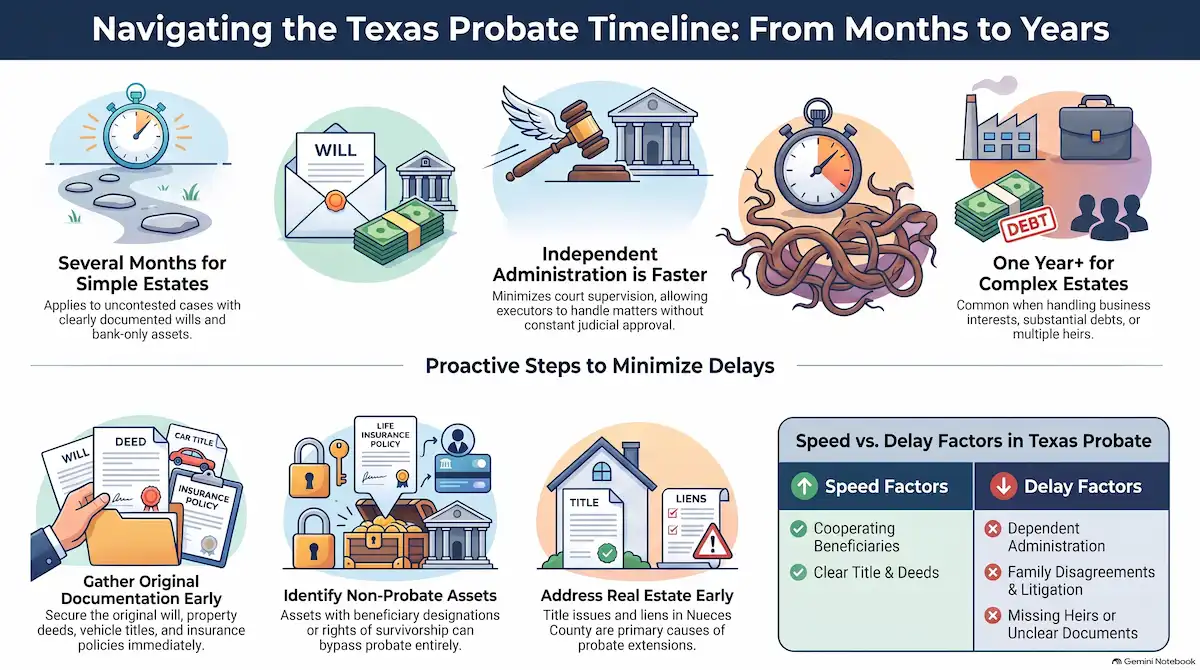
A simple, uncontested Texas probate case may take several months to complete. More complicated estates can take a year or longer, particularly when the estate includes real estate, business interests, substantial debts, multiple heirs, or disputes.
For example, an estate consisting primarily of a bank account and a clearly documented will may be much easier to administer than an estate involving a Corpus Christi home, vehicles, investment accounts, personal property, outstanding debts, and questions about ownership.
The probate process generally involves identifying the deceased person’s assets, determining who is legally entitled to receive them, addressing valid debts and claims, and distributing the remaining property. TexasLawHelp provides Texas-specific information about handling an estate, including probate and other options that may apply depending on the circumstances. Learn more about handling an estate in Texas.
Texas recognizes both independent and dependent administrationi, with the level of court supervision being an important difference between the two. The type of administration used can therefore have a major impact on how quickly an estate progresses.
Why Independent Administration Can Make Probate Faster
One reason some Texas estates move more efficiently is independent administration. This process generally involves less court supervision than dependent administration.
Under independent administration, the executor or administrator typically has greater authority to handle estate matters without obtaining court approval for every transaction. This can reduce unnecessary court involvement and make it easier to manage estate property.
This can be particularly helpful when everyone involved agrees about the estate and the deceased person’s wishes are clearly documented.
For a South Texas family handling a straightforward estate, independent administration may reduce delays. Once the executor is properly appointed and qualified, the estate can move forward with tasks such as gathering assets, addressing debts, managing property, and eventually distributing assets to beneficiaries.
However, independent administration does not mean an executor can immediately distribute everything. Required notices, filings, creditor procedures, and other legal responsibilities still need to be completed.
Why Some Texas Probate Cases Take Longer
Several issues can significantly increase the amount of time required to settle an estate. Even an estate that initially appears simple can become more complicated when problems are discovered.
Common causes of probate delays include:
- Family disagreements: Disputes between heirs or beneficiaries can slow the process and potentially lead to litigation.
- Real estate issues: A house or other property may have a mortgage, lien, title problem, unpaid taxes, or ownership questions.
- Missing heirs: Locating heirs or proving family relationships can require additional legal steps.
- Creditor claims: Outstanding debts must be reviewed and handled appropriately before the estate can be distributed.
- Unclear documents: Missing wills, deeds, financial statements, or beneficiary information can create additional work.
- Business interests: Ownership in a family business or other company may require valuation and additional legal or financial review.
These issues can be especially important in South Texas, where families may own homes, ranch property, inherited land, or other real estate that has been in the family for decades.
How Real Estate Can Affect Probate in Corpus Christi
Real estate is one of the biggest reasons a probate estate may take longer to complete. If the deceased owned a home in Corpus Christi or property elsewhere in Nueces County, the executor may need to verify ownership, review the deed, determine whether there are liens or mortgages, and decide whether the property should be transferred or sold.
A property that has been owned by a family for many years can sometimes involve complicated title records or questions about previous transfers. If several family members have an interest in the property, reaching an agreement can also take time.
This is why South Texas families should avoid assuming that probate will be finished simply because the court has accepted the will. The court proceeding is only one part of the broader estate administration process.
What Happens During Texas Probate?
Although every estate is different, probate generally involves several important steps. The will, if one exists, is presented to the appropriate court. The court determines whether the will can be admitted to probate and appoints the appropriate executor or administrator.
The person responsible for the estate then identifies and protects estate property. This may include bank accounts, vehicles, homes, land, investments, personal property, and business interests.
Debts and legitimate creditor claims must also be addressed. After the necessary estate administration tasks have been completed, the remaining assets can generally be distributed to the beneficiaries or heirs according to Texas law and the applicable estate documents.
Families can also benefit from understanding that not every asset necessarily passes through probate. Certain assets may transfer directly to beneficiaries depending on ownership and beneficiary designations.
What If There Is No Will?
When someone dies without a valid will, the estate may be handled under Texas intestate succession laws. This means Texas law determines which heirs are entitled to receive the deceased person’s property.
Probate without a will can become more complicated when there are multiple heirs, blended families, previous marriages, children from different relationships, or questions about whether property is community or separate property.
For families in Corpus Christi and other South Texas communities, these situations can sometimes involve property that has been passed informally through generations. A family may believe everyone agrees about who owns a house or piece of land, but legal ownership may require formal documentation and court proceedings.
When there is no will, determining the legal heirs may therefore add time to the probate process.

Corpus Christi and Nueces County Probate Considerations
For families handling an estate in Corpus Christi, local court procedures are an important part of the process. Nueces County publishes probate filing fees for different estate proceedings, including applications involving probate, independent administration, heirship proceedings, and other probate matters. View the Nueces County probate filing fees.
This local information illustrates why probate is not simply a matter of waiting for a court date. Different types of proceedings can involve different filings, requirements, and costs.
A Corpus Christi estate may also require attention to local property records, real estate transactions, creditor issues, and family circumstances. Working with professionals familiar with Texas and local South Texas procedures can help families identify potential issues earlier.
For families in the Coastal Bend, an estate may include a longtime family home, coastal property, land outside Corpus Christi, vehicles, business interests, or other assets that require different steps before they can be transferred.
How Families Can Help Prevent Probate Delays
Although families cannot control every part of the legal process, good preparation can reduce avoidable delays.
Executors should try to gather important documents and information as early as possible, including:
- The original will and other estate planning documents
- Deeds and property records
- Bank and investment account information
- Vehicle titles
- Insurance policies and beneficiary information
- Outstanding bills, loans, and other debts
- Contact information for beneficiaries and potential heirs
Keeping these records organized can help the executor and attorney determine what assets exist and what steps need to be completed.
Communication among family members is also important. A disagreement about a house, vehicle, personal belongings, or financial distributions can create significant delays. When beneficiaries understand the deceased person’s wishes and cooperate with the executor, an estate may be much easier to administer.
Can Probate Be Avoided in Texas?
In some situations, certain assets may pass to beneficiaries without going through traditional probate. These may include certain life insurance benefits with designated beneficiaries, property held with rights of survivorship, certain trust assets, and accounts or property with transfer-on-death arrangements.
This is one reason estate planning can be so valuable. Proper beneficiary designations and ownership structures may simplify the transfer of certain assets after death.
However, having some non-probate assets does not automatically mean the entire estate avoids probate. Someone may have retirement accounts that transfer directly to beneficiaries while still owning a Corpus Christi home that requires probate.
Understanding the difference between probate and non-probate assets can help families plan ahead and avoid unnecessary confusion when an estate needs to be settled.
When Should You Speak With a Texas Probate Attorney?
If an estate includes real estate, multiple heirs, business interests, substantial debts, unclear ownership, or family disagreements, getting legal guidance early can be beneficial.
A probate attorney can review the circumstances and explain which type of administration may be appropriate. They can also help the executor understand legal responsibilities, identify potential complications, and determine what documents and court filings may be required.
For South Texas families, local experience can be especially valuable when an estate includes property in Corpus Christi, Nueces County, or surrounding Coastal Bend communities.
The earlier potential problems are identified, the easier it may be to address them before they cause major delays.
Understanding Your Texas Probate Timeline
So, how long can probate take in Texas? There is no universal answer. A straightforward, uncontested estate with a valid will and independent administration may be completed in a relatively short period, while a complicated estate involving disputes, real estate, creditor claims, or heirship questions can take a year or longer.
The most important factor is not simply how long probate “usually” takes. It is understanding what circumstances apply to the specific estate.
For families in Corpus Christi and across South Texas, preparing the necessary documents, identifying assets, communicating with heirs, and getting appropriate legal guidance can help reduce avoidable delays.
If you are responsible for settling a loved one’s estate, do not assume that probate will follow the same timeline as another family’s estate. Every situation is different. Consult a qualified Texas probate attorney to understand your legal options, potential timeline, and the steps needed to move the estate toward a proper resolution.